Sep 29, 2026Engineering Whitepapers
How Moldflow Analysis Reduces Injection Mold Risk Before Steel Cutting
Learn how Moldflow analysis helps evaluate filling, venting, shrinkage and warpage risks before steel cutting, so mold design decisions can be made earlier and more safely.
Moldflow is most valuable before mold steel is cut.
At that stage, gate location can still be reviewed, venting can still be planned, local geometry can still be discussed, and high-risk molding issues can still be reduced without costly steel modification. That is why Moldflow should not be treated as a software presentation tool. Its real value is to support engineering decisions before tooling becomes difficult to change.
At JST Mould, we see Moldflow as part of the engineering decision chain:
DFM review → Moldflow analysis → mold design adjustment → steel cutting → T1 trial → dimensional validation
The goal is not to create colorful simulation pictures. The goal is to understand likely molding risks early enough to improve the tool design.
1. Start With Engineering Questions, Not Software Screens
A useful Moldflow review starts with practical engineering questions:
- Will the part fill in a stable and balanced way?
- Where are weld lines and air traps likely to occur?
- Are there local shrinkage risks around thick sections or gates?
- Is warpage likely to affect dimensional stability or assembly?
- Should the gate, venting, local geometry or cooling concept be adjusted before steel cutting?
The best Moldflow reports are not the longest ones. They are the ones that help the team make better decisions earlier.
2. Filling Analysis: A Part Can Fill and Still Be High Risk
One common mistake is to ask only one question:
“Can the cavity be filled?”
In practice, complete filling is not enough. Engineers also need to understand whether filling is balanced, whether pressure demand is reasonable, and whether the chosen gate arrangement creates unnecessary molding risk.
For example, a part may still fill completely while showing:
- filling imbalance
- an inefficient flow path
- pressure loss
- poor flow progression in critical areas
- weld lines in visible or functional zones
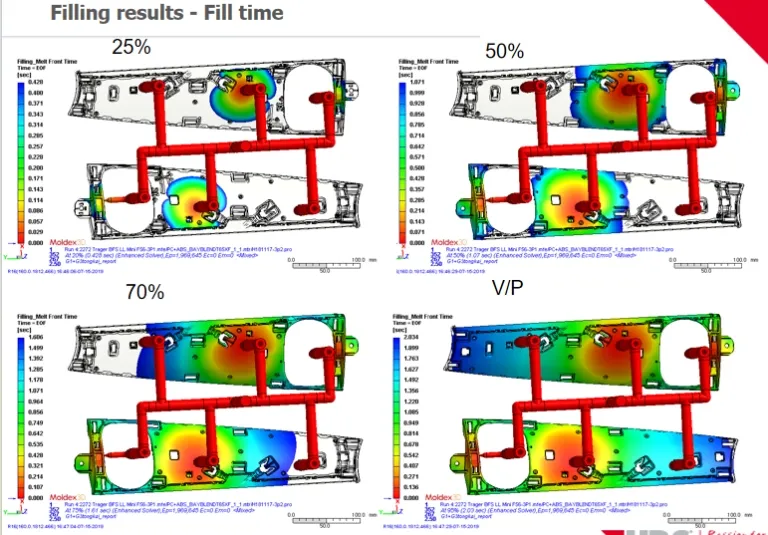
That is why filling analysis should be used to guide gate and mold design decisions, not simply to confirm that the cavity can be filled.
Fill-time analysis helps engineers review how the cavity fills and whether the proposed gate layout creates filling imbalance.
3. Air Trap and Weld Line Results Should Lead to a Venting Plan
Moldflow becomes useful only when the result changes the mold design.
If air traps are predicted near end-of-fill areas, corners, ribs or weld-line convergence zones, the next engineering question is clear:
How will the trapped air escape in the real mold?
That decision may affect:
- parting-line venting
- local vent inserts
- corner venting
- ejector-related venting
- gate layout or flow direction review
In other words, simulation results should lead directly to practical venting decisions.
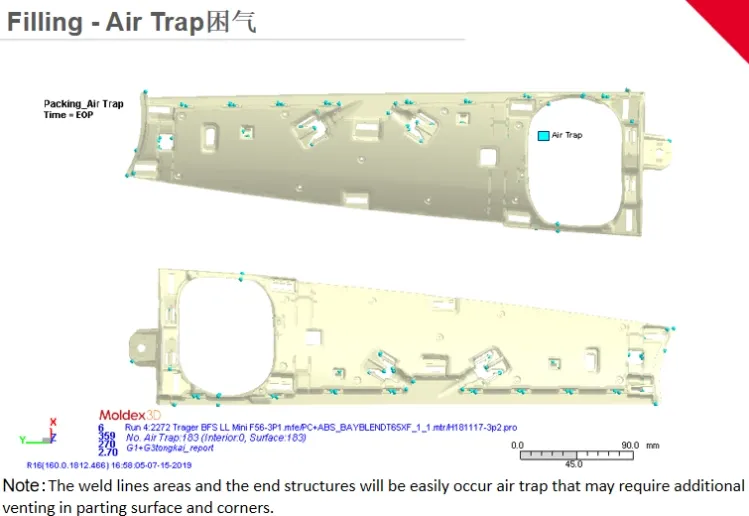
Predicted air-trap areas help engineers review parting-line venting and corner venting before the mold is finalized.
4. Packing and Shrinkage Analysis Help Detect Risk Before T1
Many molding issues are not just filling problems. Some appear later during packing and cooling, especially around gates, thicker zones, ribs, bosses and local geometry transitions.
This is where volumetric shrinkage analysis becomes useful.
Instead of waiting for T1 and then treating every visible defect as a machine-setting problem, the team can use Moldflow to identify areas that are more likely to show:
- local shrinkage concentration
- sink-related risk
- packing inefficiency
- geometry-driven risk near thicker sections
- gate-related packing sensitivity
This early review helps the engineering team decide whether the gate, wall thickness, local structure or packing strategy should be reconsidered before steel cutting.
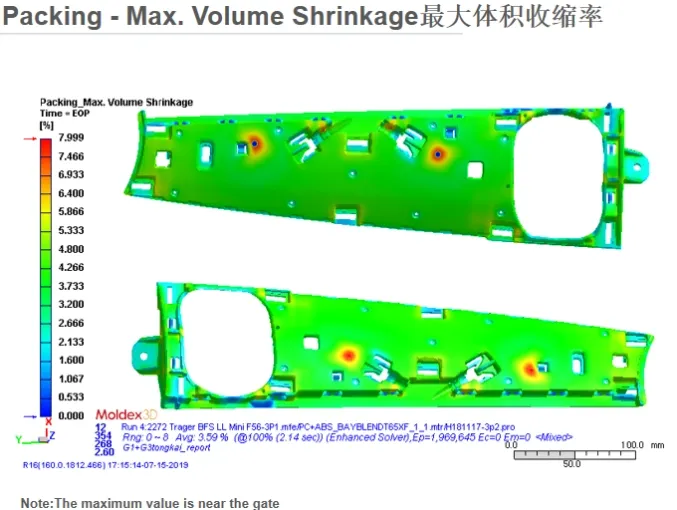
Shrinkage results help engineers review whether gate location, local structure or packing behavior may increase molding risk.
5. Warpage Analysis Is About the Cause, Not Only the Number
Warpage analysis is often misunderstood.
A deflection plot is not just a final displacement number. Its real value is to help engineers understand why a part may move, bow, twist or deform after molding.
Possible contributors include:
- differential shrinkage
- flow-induced material orientation
- geometry stiffness variation
- asymmetric cooling conditions
- gate location and flow direction
- local structural transitions
The right correction depends on the real cause.
Sometimes the solution may involve gate review. In other cases, the solution may require geometry adjustment, cooling improvement, or later compensation based on trial data. This is why warpage analysis should be connected to both mold design and later trial validation.
A simulation can help identify likely deformation trends, but the final part still has to be proven through actual molding and dimensional measurement.
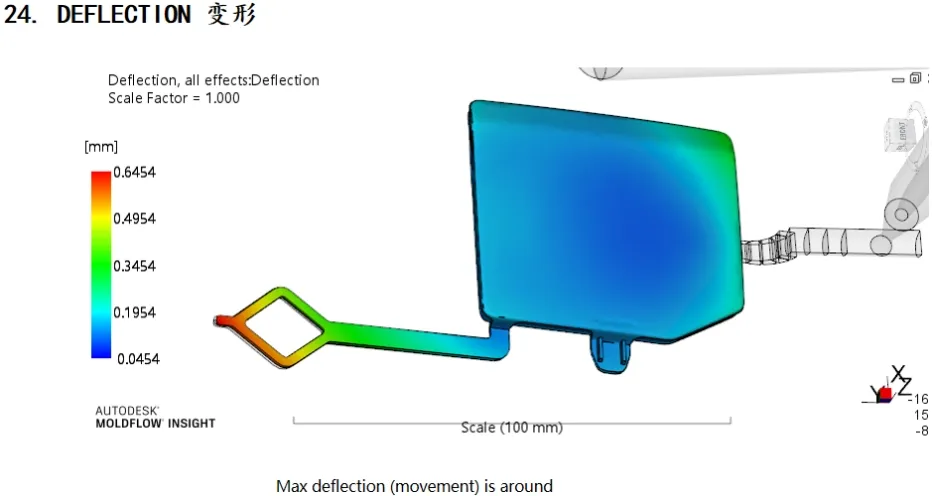
Warpage analysis is most useful when engineers review the likely deformation trend and connect it to practical design decisions.
6. Real Engineering Value: From Simulation Result to Design Decision
The real value of Moldflow is not the report itself. It is the decision that follows.
In one anonymous project review, the simulation did not just show filling, air-trap and shrinkage patterns. It also showed that the shear-rate risk at the cold gate was too high, which led to a gate-size review recommendation.
That is the correct use of Moldflow:
not “software output for presentation,” but engineering evidence for changing the mold design before machining.
This is also why Moldflow should be connected to DFM and practical tooling review. A report that does not influence gate design, venting, geometry review, or risk planning has limited engineering value.
7. Moldflow Does Not Replace Trial, but It Makes Trial More Efficient
A simulation result is only one part of the engineering process.
Actual molding behavior still depends on:
- real material properties
- processing conditions
- machine capability
- gate performance
- mold manufacturing accuracy
- cooling execution
- dimensional validation after trial
That is why the correct workflow is:
review early → reduce avoidable risk → cut steel with more confidence → validate by T1 and measurement
Moldflow helps the team enter trial with better preparation. It does not remove the need for real validation.
8. When Is Moldflow Most Valuable?
Moldflow is especially useful when a project includes:
- complicated flow paths
- large or cosmetic parts
- multiple gates
- venting-sensitive geometry
- shrinkage-sensitive structure
- flatness or deformation requirements
- engineering plastics with tighter dimensional expectations
- expensive or difficult-to-modify tooling
The later a major problem is found, the more expensive it usually becomes.
That is why using Moldflow before steel cutting often delivers the greatest value.
FAQ
Can Moldflow guarantee that a mold will pass T1 without modification?
No. Moldflow helps identify and compare risk before steel cutting, but the final molded result still depends on the actual material, machine, mold construction, cooling, processing and part geometry.
Which Moldflow results are most useful for mold design?
For many projects, filling balance, air traps, volumetric shrinkage and warpage results are highly useful because they can directly influence gate review, venting design, local geometry review and risk planning.
Should Moldflow be done before final mold design?
For risk-sensitive parts, yes. The main purpose is to influence design decisions early enough that changes can still be made before tooling becomes difficult to modify.
Need a Pre-Steel Mold Risk Review?
If your project has difficult filling, venting-sensitive geometry, shrinkage risk or dimensional stability concerns, send us the available 3D CAD, material information and critical requirements.
JST Mould can review DFM and molding risks before tooling decisions are finalized, then connect the analysis to practical mold-design recommendations.