
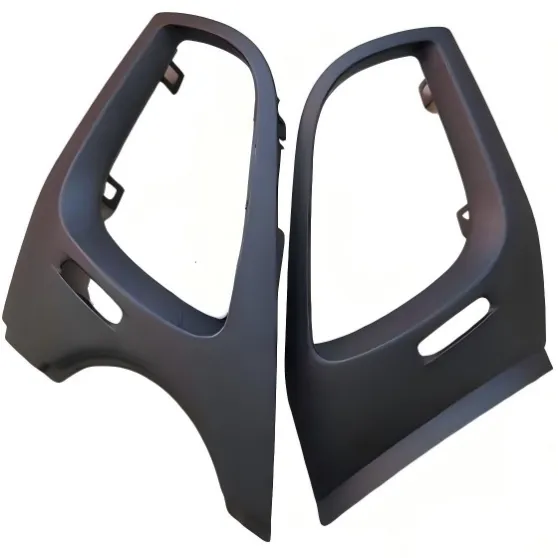
Automotive
Automotive Exterior Pillar Trim | Precision Injection Molding
Precision injection-molded automotive exterior pillar trim with tooling focused on surface consistency, dimensional stability, clip and mounting features, warpage control and repeatable assembly fit.
Specifications
- Material:
- PP+EPDM-TD15 / PC+ABS (Weather-Resistant Automotive Grade)
- Process:
- High-Pressure Injection Molding (Low-stress filling to prevent warping)
- Mechanism:
- Internal Angled Lifters & Multi-Slide System for concealed snap-fits
- Tolerance:
- +/- 0.10mm (Strict Gap & Flushness control for body alignment)
- Surface Finish:
- Mold-Tech Texture (MT) / VDI 3400 Ref. 30 (UV-Stable Matte)
- Mold Steel:
- 1.2738HH / 718H (Hardened HRC 35-38 for large-span stability)
- Quality Control:
- 100% CMM Validation / Checking Fixture Gap & Flush Analysis
Product Description:
This automotive exterior pillar trim is a molded plastic component designed for exterior body-side applications where surface consistency, dimensional stability and reliable mounting are important.
Exterior trim parts can include curved surfaces, clips, mounting bosses, local cut-outs and mating edges that must remain stable after molding and during vehicle assembly. For this type of component, mold design should consider not only appearance, but also part release, warpage, cooling balance and the dimensional relationship between mounting features and visible edges.
JST Mould supports similar automotive exterior trim projects from DFM review and mold design through tooling, mold trials and dimensional validation according to confirmed customer drawings, resin specifications and production requirements.
Key Tooling Considerations
Automotive exterior pillar and body-side trim components may present several molding challenges:
- long or curved flow paths
- visible exterior surfaces
- local ribs and mounting bosses
- clip and snap-fit features
- cut-outs or openings
- wall-thickness transitions
- warpage around long edges
- dimensional alignment with adjacent components
- ejection without visible deformation
A stable tooling solution should balance part appearance, structural stiffness, dimensional control and reliable release from the mold.
Surface and Appearance Control
Exterior trim components often contain visible surfaces that must remain consistent after molding.
The tooling review should consider:
- parting-line placement
- gate location
- weld-line risk
- ejector placement
- local sink-mark risk
- texture or surface-finish requirements
- handling of visible edges
Surface expectations should be defined according to the customer drawing and approved appearance standard rather than assumed from a generic automotive requirement.
Warpage and Dimensional Stability
Long or curved trim parts can be sensitive to differential shrinkage and cooling imbalance.
Potential causes of distortion include:
- uneven wall thickness
- asymmetric ribs
- local material accumulation
- gate position
- packing imbalance
- cooling variation
- premature ejection
During DFM and mold design, these factors should be reviewed together because a small dimensional change can affect mounting points, edge alignment and final assembly fit.
Where appropriate, Moldflow analysis can support decisions related to filling, packing, cooling and warpage before steel cutting.
Clip, Boss and Mounting Feature Design
Mounting features are critical to the final fit of an exterior trim component.
Clips, bosses and local attachment structures should be reviewed for:
- adequate draft
- release direction
- local wall thickness
- sink-mark risk
- stiffness
- undercut requirements
- ejection support
- dimensional relationship to mating surfaces
If side actions, lifters or other release mechanisms are required, the tooling concept should be confirmed during DFM before detailed mold construction.
Cooling and Ejection
Balanced cooling helps improve dimensional repeatability across long exterior trim geometry.
The mold should provide sufficient cooling around thick local features, ribs and mounting areas while maintaining practical mold construction and maintenance.
Ejection should be distributed through stable regions of the part to reduce local bending, whitening or deformation.
The final ejection concept depends on the actual geometry, draft, resin and surface requirements.
Material and Tooling Strategy
The production resin should be selected according to the customer specification and the functional requirements of the component.
Material selection can influence:
- shrinkage
- stiffness
- cavity pressure
- surface appearance
- cooling behavior
- warpage
- mold wear
Mold steel, gate system, cooling layout and dimensional compensation should therefore be defined based on the confirmed project requirements rather than a generic material assumption.
Mold Trial and Validation
During mold trials, the engineering team may evaluate:
- filling behavior
- visible surface quality
- weld lines
- flash
- sink marks
- warpage
- mounting-feature dimensions
- clip and boss integrity
- part release
- assembly fit
- repeatability across multiple shots
The objective is to establish a stable mold and process combination that can repeatedly produce parts according to the agreed drawing and validation criteria.
Typical Applications
This type of tooling approach can be applied to automotive exterior plastic trim such as:
- pillar trim components
- body-side decorative trim
- rear-quarter trim
- exterior garnish components
- similar curved automotive trim parts with clips and mounting features
Request a Tooling Review
If you are developing an automotive exterior trim component, you can send JST Mould your 3D CAD, resin specification, annual volume, appearance requirements and assembly-critical dimensions for an initial tooling review.