
Oct 15, 2026Engineering Whitepapers
Injection Mold DFM Before Quotation: RFQ Checklist
What should mold makers review before quoting? Learn how CAD, resin grade, critical tolerances and production data shape injection mold DFM, tooling risks and RFQ accuracy.
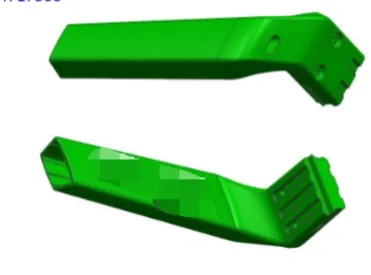
An injection mold quotation is not simply a price assigned to a 3D model. It is an engineering proposal based on assumptions about how the part will be molded, how many parts are needed, which dimensions must be controlled, and where the finished mold will run.
For an OEM buyer or product engineer with CAD already available, a practical DFM (design for manufacturability) review before quotation can reveal the decisions that actually change tooling cost: parting direction, undercuts, slider requirements, gate limitations, shrinkage risks, steel selection, cavity count and inspection expectations.
The aim is not to complete the final mold design before receiving a price. It is to identify significant uncertainties early enough that a quotation is technically meaningful—and any remaining assumptions are visible.
What Does DFM Before Injection Mold Quotation Actually Cover?
Pre-quotation DFM is a focused evaluation of whether a plastic part can be manufactured by injection molding under the proposed material, appearance, dimensional and production requirements. It typically reviews geometry, release direction, local wall sections, potential side actions, gating constraints and the requirements that may affect mold construction.
This is different from a full post-order DFM package. A preliminary review may identify a likely slider or a high-risk cosmetic surface without finalizing runner dimensions, cooling circuits, simulation results or every mold component.
A useful outcome is a decision: which requirements are fixed, which can be optimized, and which must be quoted as an explicit assumption.
1. Provide Usable 3D CAD—and Identify What Is Frozen
A STEP or Parasolid solid model is a good starting point. Assembly CAD can be especially helpful when a molded part must fit a PCB, gasket, metal insert or mating housing.
The mold maker should be able to determine the intended part orientation, basic dimensions, nominal wall sections, holes, ribs, bosses, clips and possible undercuts. A screenshot or STL file may communicate the shape but is less useful for reliable geometric assessment than editable solid geometry.
Just as important, indicate whether the model is released for quotation, still under design review, or subject to expected changes. If the CAD and 2D drawing have different revision levels, state which controls the RFQ.
Pre-quotation DFM questions:
- Does the proposed pull direction allow the part to release without side actions?
- Which features require sliders, lifters, hand-loaded inserts or a design revision?
- Are there very thin steel conditions, sharp transitions or difficult shut-offs?
- Can draft be added without changing assembly function or external appearance?
- Are there hidden geometry changes expected after the quotation?
An undercut is not automatically a design defect. But an overlooked undercut can turn a simple open-and-close mold into a more complex mechanism with different cost, lead time and maintenance requirements.
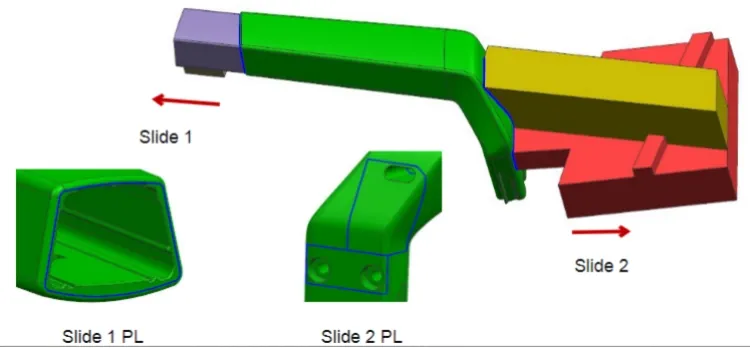
Pre-quotation tooling concept showing two side-action directions and proposed parting lines; actual mold design is finalized after engineering review.
2. Specify the Actual Resin Grade, Not Only “Plastic”
Material is a tooling input, not merely a per-part purchasing choice. A quote based on unfilled ABS may no longer represent the same mold requirements if the final material is glass-fiber-reinforced PA66, flame-retardant PC+ABS or a corrosion-sensitive compound.
Provide the resin manufacturer and grade where known, including reinforcement, flame-retardant requirements, color and any relevant approval documentation. If the final grade is not yet selected, identify a proposed grade and clearly label the specification as pending.
The material choice influences shrinkage behavior, wall-thickness feasibility, flow length, venting, gate wear, corrosion considerations, surface finish and processing temperature. For fiber-reinforced resins, orientation-dependent shrinkage may also affect critical dimensions and warpage.
A DFM review should not apply one universal shrinkage allowance to every grade and geometry. The supplier needs to assess the selected resin together with gate concept, flow direction, part shape and tolerances.
3. Separate Critical Tolerances From General Dimensions
A 3D model defines nominal geometry, but it does not tell the mold maker which dimensions determine product acceptance. A controlled 2D drawing, when available, should identify datums, critical-to-quality (CTQ) features, fits, positional relationships and any special measurement or conditioning requirements.
For example, a cosmetic enclosure may have generous tolerance on an internal rib but a tight requirement around a connector opening or mating snap-fit. Treating every dimension as equally critical can produce an unnecessarily costly proposal; ignoring the functional dimensions can produce a mold that is inexpensive but unsuitable.
Before quotation, tell the supplier:
- Which dimensions affect assembly, sealing, electrical fit or moving components?
- Are the tolerances specified for molded parts after a defined conditioning period?
- Which features require inspection records or a customer-specific acceptance method?
- Do the CAD model and drawing use the same revision, datum system and units?
A quoted tolerance is not a guaranteed outcome merely because it appears on a drawing. It needs to be evaluated against material behavior, geometry, process capability, measurement method and agreed acceptance conditions.
4. Show Surface, Gate and Parting-Line Restrictions
The most convenient gate location for filling is not always acceptable for appearance, assembly or strength. Likewise, a parting line or ejector mark may be harmless on a hidden surface but unacceptable on a visible front face.
Mark the A-surfaces, texture or polish zones, prohibited gate areas, permissible witness marks and any sealing surfaces. For coated or decorated parts, identify downstream finishing requirements early.
This information can determine whether the supplier proposes a different parting direction, hot-runner concept, side action or surface treatment. It can also identify areas that need a closer review of weld lines, sink marks, venting and ejection marks during later engineering.
5. Share Production Volume and Where the Mold Will Operate
A mold intended for several thousand parts annually may not require the same cavity count, wear resistance or automation level as one producing hundreds of thousands of parts. Give an estimated annual quantity, demand pattern, target mold life and—if known—lot sizes and target part cost.
Also tell the mold maker whether JST will produce the molded parts or whether the tool will be shipped to another molding plant. For an export mold, the receiving machine's tonnage, tie-bar spacing, platen interface, locating ring, ejection, water and hot-runner connection requirements may directly affect the design and quote.
Production data helps make the trade-off between initial tooling cost and long-run piece cost explicit. Cavity count should follow realistic demand and molding constraints, not a generic preference for more cavities.
6. Identify Cost-Changing DFM Risks Before Comparing Prices
A useful pre-quotation DFM conversation prioritizes risks according to the impact on the commercial proposal.
Potential DFM finding | Why it changes the quote | What the buyer should clarify |
|---|---|---|
Side undercut or snap-fit | May require a slider, lifter or alternate part design | Can this geometry or opening direction change? |
Thick boss or abrupt wall transition | May raise sink, void, cooling and dimensional concerns | Is the wall thickness or appearance requirement negotiable? |
Limited gate locations | Can constrain filling, weld-line position and runner approach | Which areas are cosmetic, functional or gate-prohibited? |
Tight assembly tolerance | May influence mold strategy, trial iterations and inspection planning | Which dimensions are truly CTQ and how will they be measured? |
Reinforced or demanding resin | Can change shrinkage, wear, venting and steel considerations | What is the exact resin grade and service condition? |
High annual quantity | May change cavity count, runner choice, steel and maintenance assumptions | What annual demand and tool life should the quote cover? |
Export mold interface | Can change mold-base and system specifications | Which receiving machine and plant standard apply? |
Two mold quotations can differ substantially because suppliers have priced different answers to these questions—not simply because one is more efficient.
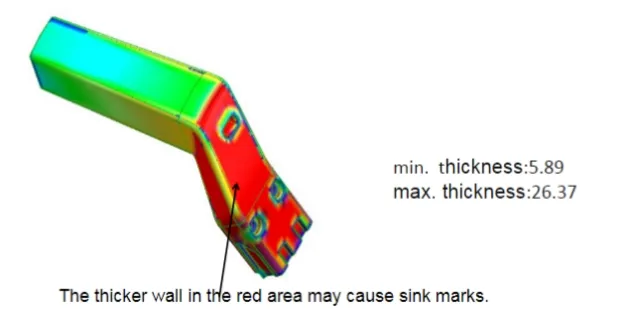
Engineering DFM example: localized thick sections are flagged for potential sink and cooling risks. Assessment depends on the full geometry and material.
7. Decide What Must Be Resolved Now and What Can Wait
Not every unresolved detail should block an initial quotation. The key is to distinguish price-driving uncertainties from information that can be confirmed during detailed mold design.
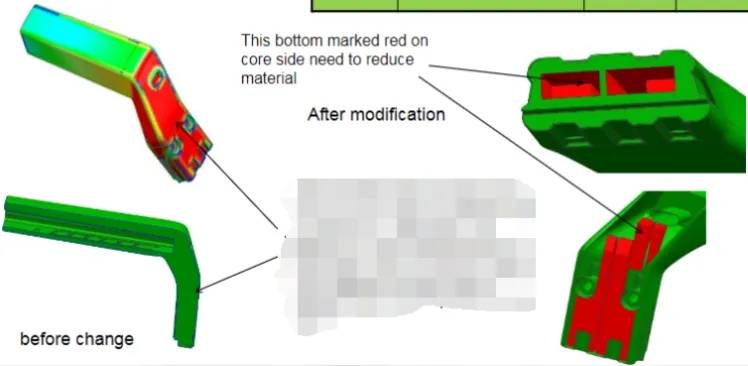
DFM review example: a suggested geometry modification reduces an overly thick local section. Final feasibility requires customer approval and validation.
Resolve before a firm tooling quote: the CAD revision, resin assumption, principal part dimensions, major undercuts, intended production volume, critical functional requirements, mold destination and major finish or gate restrictions.
May remain provisional if clearly stated: final gate size, complete cooling layout, detailed runner balancing, final steel for individual components, advanced simulation outcomes and full trial or inspection documentation.
When an uncertainty affects tooling architecture—for example, whether a side opening can be redesigned to remove a slider—request a clearly defined quotation option rather than silently assuming the cheaper solution.
An Example: Two Quotes for the Same Enclosure CAD
Consider a hypothetical electronic enclosure with a connector window, internal snap-fits and a textured outer surface. Supplier A assumes the connector opening can be redesigned so the part releases in the main mold-opening direction. Supplier B assumes the opening is frozen and quotes a side action. Their tooling prices cannot be compared fairly until the buyer clarifies which geometry is required.
Now add a specified flame-retardant resin, a critical PCB locating dimension and a mold destined for the customer's overseas plant. Those details can affect shrinkage review, inspection requirements and machine compatibility even though the visible CAD model has not changed.
The lesson is straightforward: a quotation becomes more reliable when the supplier knows what the design must achieve, not only what it currently looks like.
A Focused Pre-Quotation DFM Handover Checklist
Use this short package to start a technically meaningful review:
- 3D CAD: STEP or Parasolid file, part number, revision and assembly data if relevant.
- 2D drawing: if available, with key dimensions, datums and CTQ tolerances clearly identified.
- Material: resin manufacturer/grade or a clearly stated provisional material.
- Part appearance: texture, visible surfaces, prohibited gate/ejector marks and sealing zones.
- Production: annual volume, approximate tool life, production location and target schedule.
- Constraints: features that cannot change, preferred tooling standards and receiving molding machine information for exported molds.
- Open questions: decisions the mold supplier should flag for engineering review instead of guessing.
For a broader RFQ package checklist, see our Injection Mold RFQ Preparation Guide. The difference is that this article focuses on the technical decisions that should be evaluated before quotation, while the RFQ guide explains the wider information package needed to request comparable bids.
Frequently Asked Questions
Can a mold maker perform DFM before I place a tooling order?
Yes. A preliminary manufacturability review can identify obvious release, wall-thickness, material, appearance and tolerance risks before a tooling order. Its scope should be agreed in advance; it is not the same as a fully approved final mold design.
Is a 3D CAD file enough to request an injection mold quotation?
A usable 3D model is often enough to begin an initial assessment, but resin, volume, critical dimensions and production requirements are needed to reduce assumptions. A preliminary price should identify any significant items not yet confirmed.
Do I need a complete 2D drawing before DFM review?
Not always. Start with the available CAD and provide the known critical dimensions and assembly requirements. However, a controlled drawing or equivalent specification is important before finalizing dimensions, acceptance criteria and tooling commitments.
Does DFM always mean the customer must redesign the plastic part?
No. DFM may confirm that the geometry is feasible, identify a tooling mechanism, or show optional design improvements. Changes should be weighed against product function, certification, assembly and commercial constraints.
Can DFM guarantee the final mold price or part tolerance?
No. Early DFM improves the basis of a quotation but cannot eliminate every uncertainty. Final cost and acceptance depend on agreed specifications, detailed tool design, trials and any subsequent design changes.
Ready to Request an Engineering-Based Mold Quotation?
If you already have 3D CAD and are preparing an RFQ, send JST Mould the model together with your resin grade, critical dimensions, expected annual volume and target production location. Indicate which design features are fixed and which are open for engineering discussion.
We can review the available information, highlight the main tooling questions and discuss the appropriate next steps for a quotation. If your project is covered by an NDA, please flag the confidentiality requirements before sharing restricted files.