
Aug 25, 2026Precision Engineering & Tooling
Conformal Cooling vs. Traditional Straight Cooling Lines: Solve Common Injection Mold Pain Points
Eliminate mold hot‑spots, reduce warpage & cut cooling times. Learn how metal **3D printed conformal cooling** inserts outperform traditional straight cooling lines for automotive, medical & electroni
In plastic injection molding, cooling accounts for 50% to 80% of the total molding cycle time. The cooling system heavily governs part quality, cycle time, and overall unit manufacturing cost — critical for automotive, medical, and consumer‑electronics export tooling projects.
However, conventional subtractive manufacturing (CNC drilling and gun drilling) restricts cooling galleries to straight lines. Straight water channels cannot follow complex curved cavity contours, deep ribs, narrow lifter zones, or slender deep‑cavity cores, causing severe heat traps and extended cycle times.
By leveraging SLM metal 3D printing for mold inserts, 3D printed conformal cooling channels for injection molding break traditional tooling barriers. Internal cooling passages curve freely to match 3D cavity profiles, delivering four major core advantages for global mold makers.
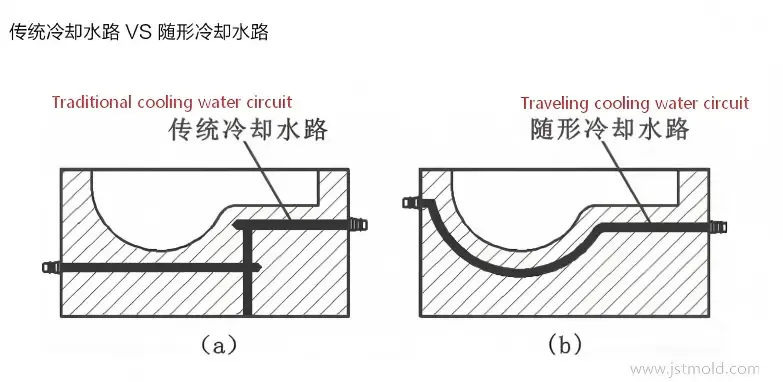
Figure 1: Cross-section comparison between traditional straight drilled cooling lines and 3D printed conformal cooling channels.
1. Boost Cooling Efficiency & Shorten Molding Cycle Times
Eliminating Cooling Blind Spots
A conformal cooling mold insert reaches deep pockets, thick ribs, slender cores, and complex curved surfaces that straight drilling cannot access, completely removing localized core heat accumulation.
Maximizing Thermal Transfer Rate
Curved, spiral, or bifurcated 3D channels provide a significantly larger heat‑exchange surface area compared to straight drilled holes. They optimize fluid dynamics to induce turbulent coolant flow, accelerating heat removal and cutting the overall cooling phase by 30% to 50%.
2. Improve Part Quality & Mass‑Production Yield Rates
Uniform Mold Temperature Control
Precise zonal cooling layout keeps mold surface temperature variation within tight, consistent limits: dense channels in thick‑walled regions and sparse channels in thin‑walled areas. This is especially valuable for demanding applications such as automotive optical components and medical precision parts.
Reduce Molding Defects
Synchronized, uniform cooling reduces differential thermal shrinkage, eliminating severe part warpage, sink marks, vacuum bubbles, thermal cracking, gate stringing, and optical yellowing. Mass‑production yields can routinely rise to 95%+.
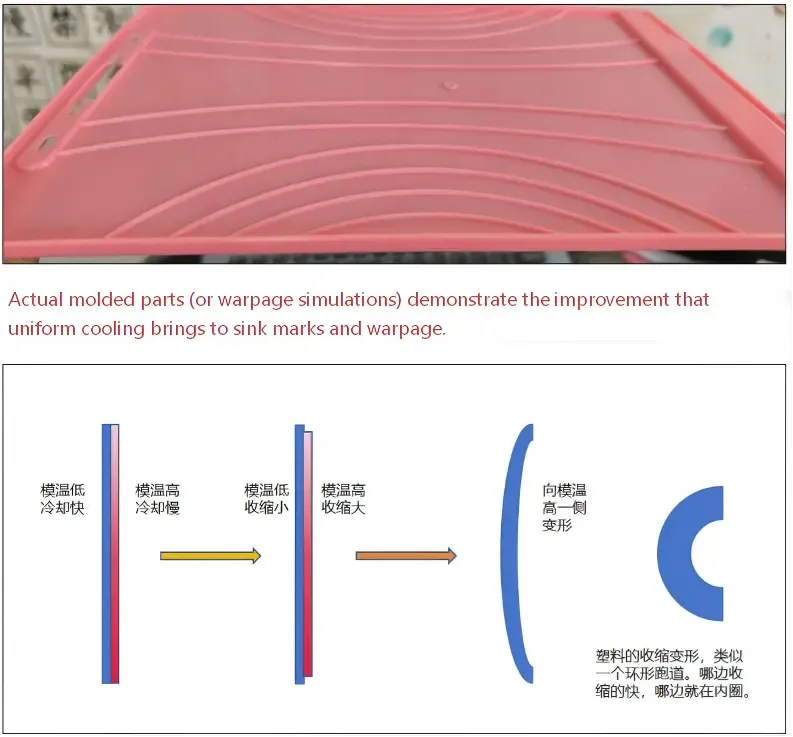
Figure 2: Conformal cooling galleries follow complex cavity contours to eliminate localized core heat accumulation.
3. Extend Tool Life & Reduce Total Operational Costs
Mitigate Thermal Fatigue Damage
Minimizing temperature deltas across core inserts reduces cyclic thermal expansion and contraction stress, extending mold service life by 30% to 50%. This delivers long‑term value for high‑volume automotive and medical production runs.
Lower Energy & Press Expenses
Drastically reduced cooling times decrease the operating hours of shop‑floor chillers and temperature control units, generating substantial long‑term energy savings on high‑volume production runs.
4. Accommodate Complex Geometries via Additive Manufacturing
One‑Piece Additive Manufacturing
Metal 3D printing bypasses multi‑stage CNC setups, fabricating complex integrated internal cooling networks directly into one‑piece steel inserts or 3D printed lifter with conformal cooling.
Solve Difficult Cooling Geometries
Conformal cooling is ideal for deep pockets, slender high‑aspect‑ratio cores, non‑uniform wall thicknesses, optical curved surfaces, and complex lifter structures where standard baffle pipes or gun drilling fail.
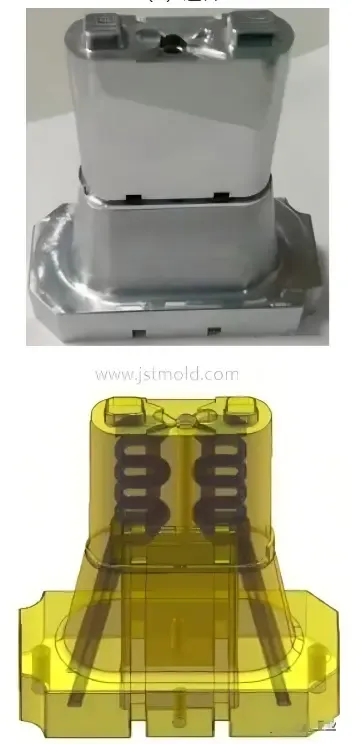
Figure 2: Conformal cooling galleries follow complex cavity contours to eliminate localized core heat accumulation.
🔍 Advanced Tooling Design & Moldflow Simulation
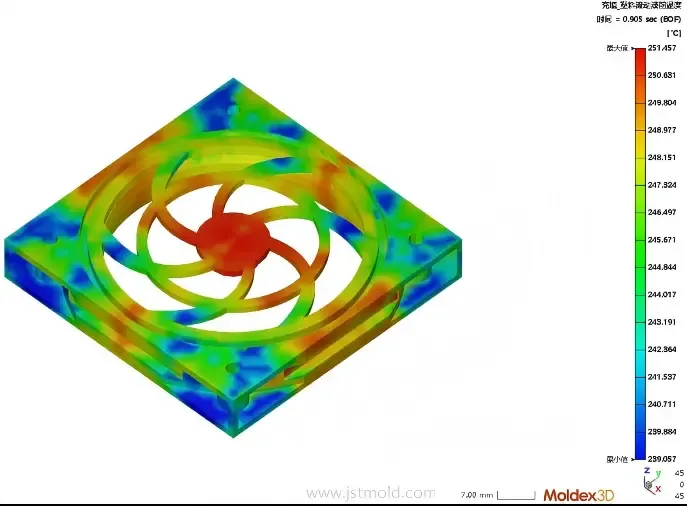
To ensure proper flow velocity, optimize pressure drop, and avoid channel clogging, JST Mold never relies on guesswork. We use advanced Moldex3D thermal simulation software to analyze plastic melt flow, optimizing channel diameters, wall proximity, and coolant pressure drops before metal printing.
Want real shop‑floor production data covering consumer electronics, automotive optics, lifter tooling, and medical deep‑cavity molds? Read our hands‑on Case Study: 33% Cycle‑Time Reduction via 3D‑Printed Conformal Cooling, with verified shop‑floor test metrics.
Figure 5: Moldex3D thermal simulation analysis ensuring optimal flow velocity, pressure drop, and cooling performance.
Frequently Asked Questions
Q1: What makes a conformal cooling 3D printed mold superior to traditional straight cooling lines?
Traditional straight cooling lines rely on drilled holes that cannot follow 3D curved surfaces, deep core pockets, or slender lifter geometry, creating hot spots and long cycle times. Conformal channels are 3D printed to follow exact part contours, ensuring uniform heat extraction and faster cooling.
Q2: Can a conformal cooling mold insert be applied to deep cores and monolithic molding structures?
Yes. Conformal cooling is especially effective for complex cores, slender high‑ratio medical pins, and monolithic molding designs where conventional drilling would interfere with ejector pins or structural ribs.
Q3: How does conformal cooling extend overall injection mold lifespan?
By maintaining a balanced temperature distribution across the steel insert, conformal channels reduce localized thermal stress caused by continuous heating and cooling cycles, extending mold tool life by 30% to 50%.
Q4: Is metal 3D printed tooling suitable for mass‑production export molds?
Absolutely. Using Direct Metal Laser Sintering (DMLS / SLM) with high‑grade maraging tool steel (1.2709), inserts are post‑heat‑treated to 50–54 HRC, delivering excellent wear resistance for high‑volume automotive, medical, and electronics export molding.
Q5: Do micro conformal cooling channels get clogged during mass production?
With properly optimized channel dimensions, internal surface post‑treatment, and standard industrial cooling‑water filtration systems, clogging is rarely observed in real‑world mass‑production export molds.
💬 Ready to Eliminate Mold Hot‑Spots & Boost Output?
Troubled by excessive cycle times, part warpage, or overheated lifters on your automotive, medical, or electronics export tooling projects?
Partner with JST Mold to unlock the full potential of metal 3D printed conformal cooling technology. Our engineering team provides end‑to‑end tooling expertise: from Moldex3D thermal simulation to precision SLM metal printing and T1 trial validation.
📩 Get Your Free DFM & Conformal Feasibility Review Today!
Send us your 3D CAD files for technical assessment and ROI & payback calculation: info@jstmould.com
Facility Location: Shenzhen, Guangdong, China